Regoutz Group


Laying the groundwork for optoelectronic devices – the influence of stabiliser concentration on the formation of In2O3 thin films

The influence of stabiliser concentration on the formation of In2O3 thin films
A. A. Riaz, C. Kalha, M. Basso, M. Furedi, and A. Regoutz, Journal of Materials Chemistry C, 13, 177, 2025.

In2O3 is the parent oxide semiconductor for many transparent conducting oxides owing to its comparatively wide band gap and reasonable conductivity. The ability to fabricate thin films of In2O3 utilising simple and cheap solution-processed methods such a sol-gel has made it appealing for applications in displays and solar cells. The use of stabilisers in sol-gel synthesis is prevalent in current research to maintain the solution stability over time and facilitate the formation of strong M–O–M bonds. However, understanding the fundamentals behind the chemistry, especially the effect of varying the stabiliser concentration, is essential and often overlooked.

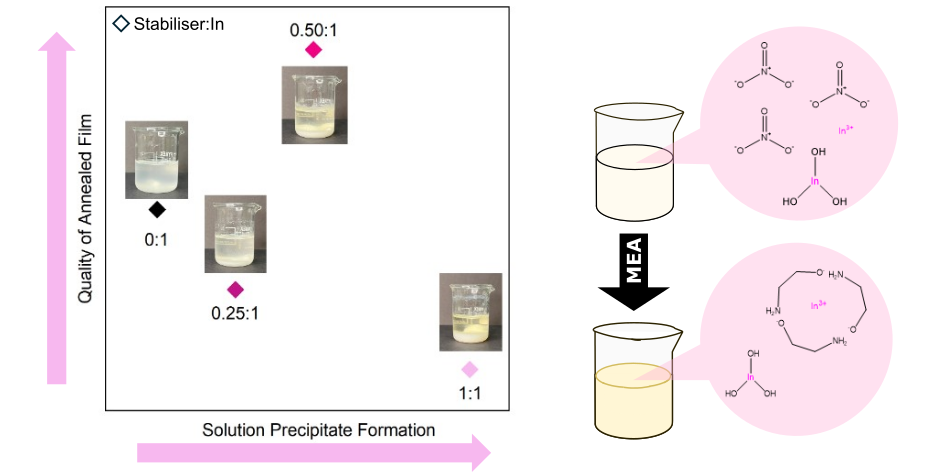
In our paper published in RSC Journal of Materials Chemistry C and led by Aysha Riaz, we show the impact on the quality of In2O3 thin films when altering the concentration of monoethanolamine used as a stabiliser. Utilising a combination of characterisation techniques such as X-ray photoelectron spectroscopy, atomic force microscopy, and ellipsometry to probe the chemistry of the thin films and UV-visible and infrared spectroscopy to follow the solution chemistry, the optimum stabiliser ratio concentration was determined.

This is the first first author research paper of Aysha’s PhD, with hopefully more to follow! Curran Kalha and Maria Basso provided support and training and the ellipsometry data were collected with the help of Máté Füredi.
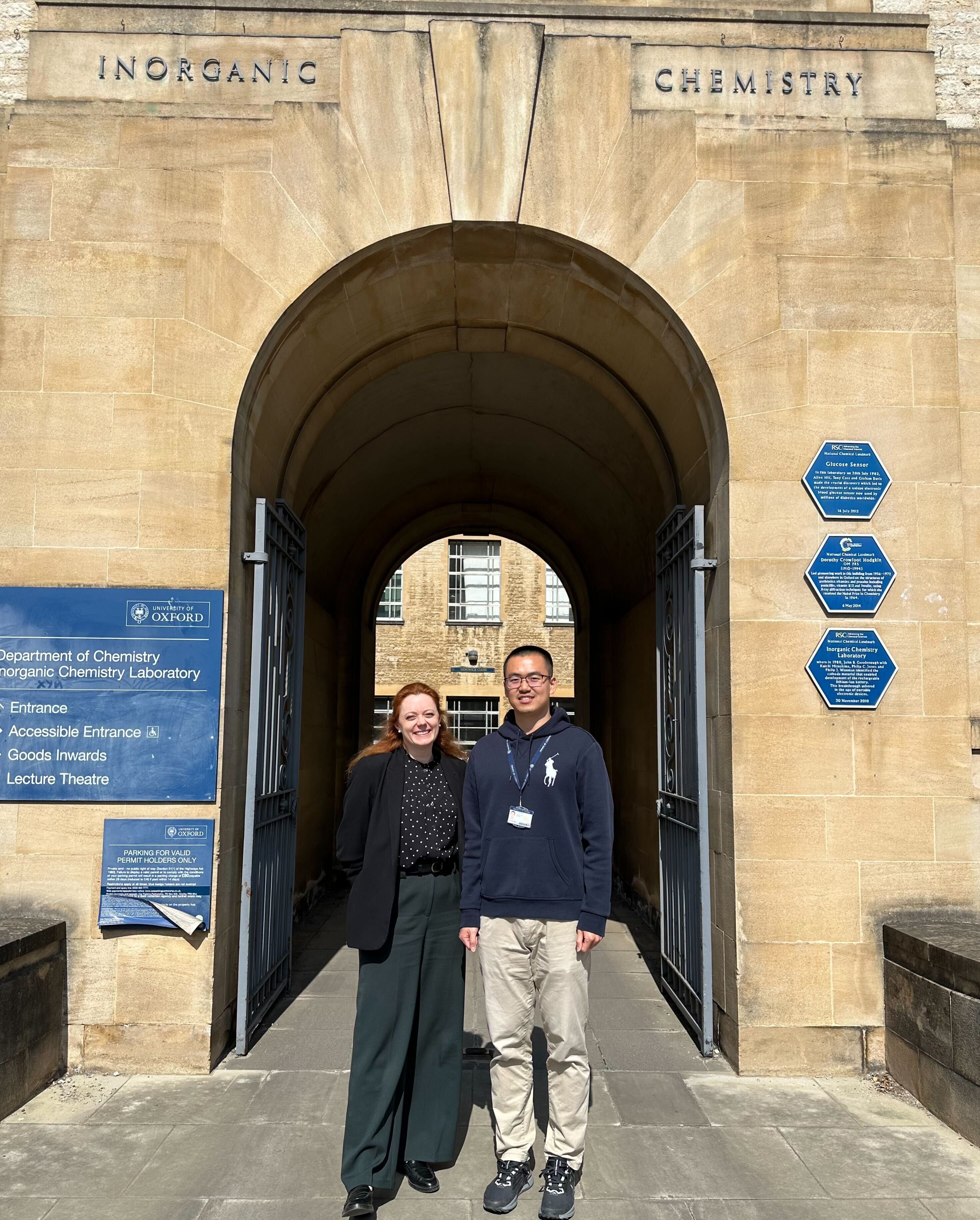

Congratulations Dr Zhu!

Yujiang successfully defended his PhD thesis on the 5th of February – congratulations!

Yujiang’s thesis explored how wet synthesis parameters could be tuned to obtain copper oxide nanostructures of varying characteristics and understand how these relate to their performance in non-enzymatic glucose sensors. He was able to show that changes as little as a few degrees Celsius in the synthesis temperature can dramatically change the nanostructure morphology and consequently the sensing properties.

To date, Yujiang has published one paper based on his PhD work, which you can read here, with more in the pipeline. His examiners were Dr John Hardy from the University of Lancaster and Prof Gopinathan Sankar at UCL – a big thank you to both of them! Throughout his PhD Yujiang has also contributed to collaborations inside and outside of the group resulting in four co-authored papers.

We are fortunate enough that Yujiang is spending a little more time with us now in Oxford before starting a job later this year. We are excited to follow his career and so delighted we could be part of it!


Masters’ success

This year the group hosted three Chemistry undergraduate final year students for their research project: Emila Duka, Shiyang (Ann) Lu, and Obina Uba. Emila and Obina worked on doped indium oxide thin films together with Aysha and Ann worked on core and valence spectroscopy of OLED materials from experiment and theory co-supervised by Dr Laura Ratcliff from the University of Bristol. Prajna supported with her XPS and XRD expertise.

Emila, Ann and Obina became integral members of the group and we were happy to celebrate their success in both producing high quality theses (see physical blue copy in images below) and engaging final research presentations (see “live” images below).


COAST in Vienna

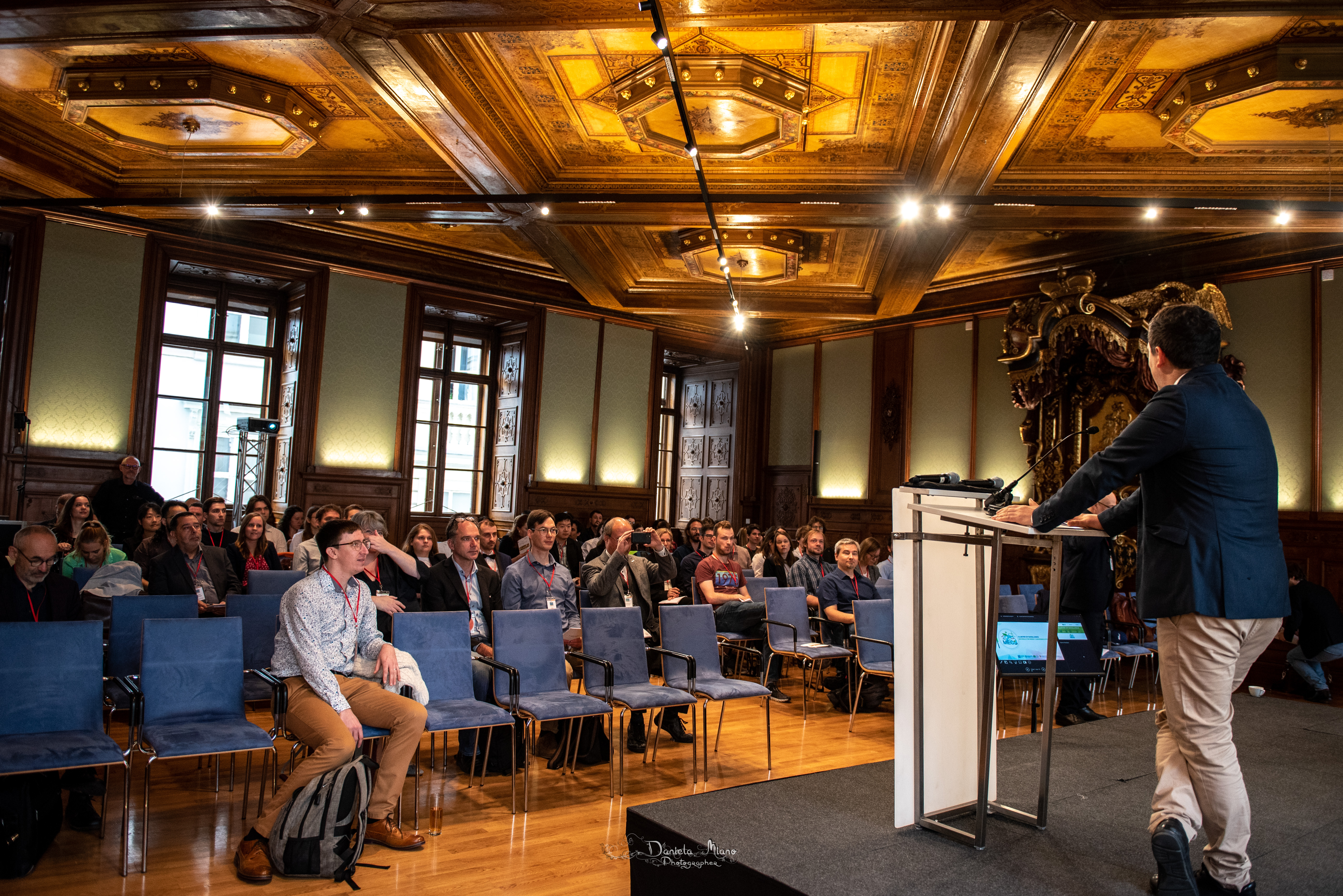
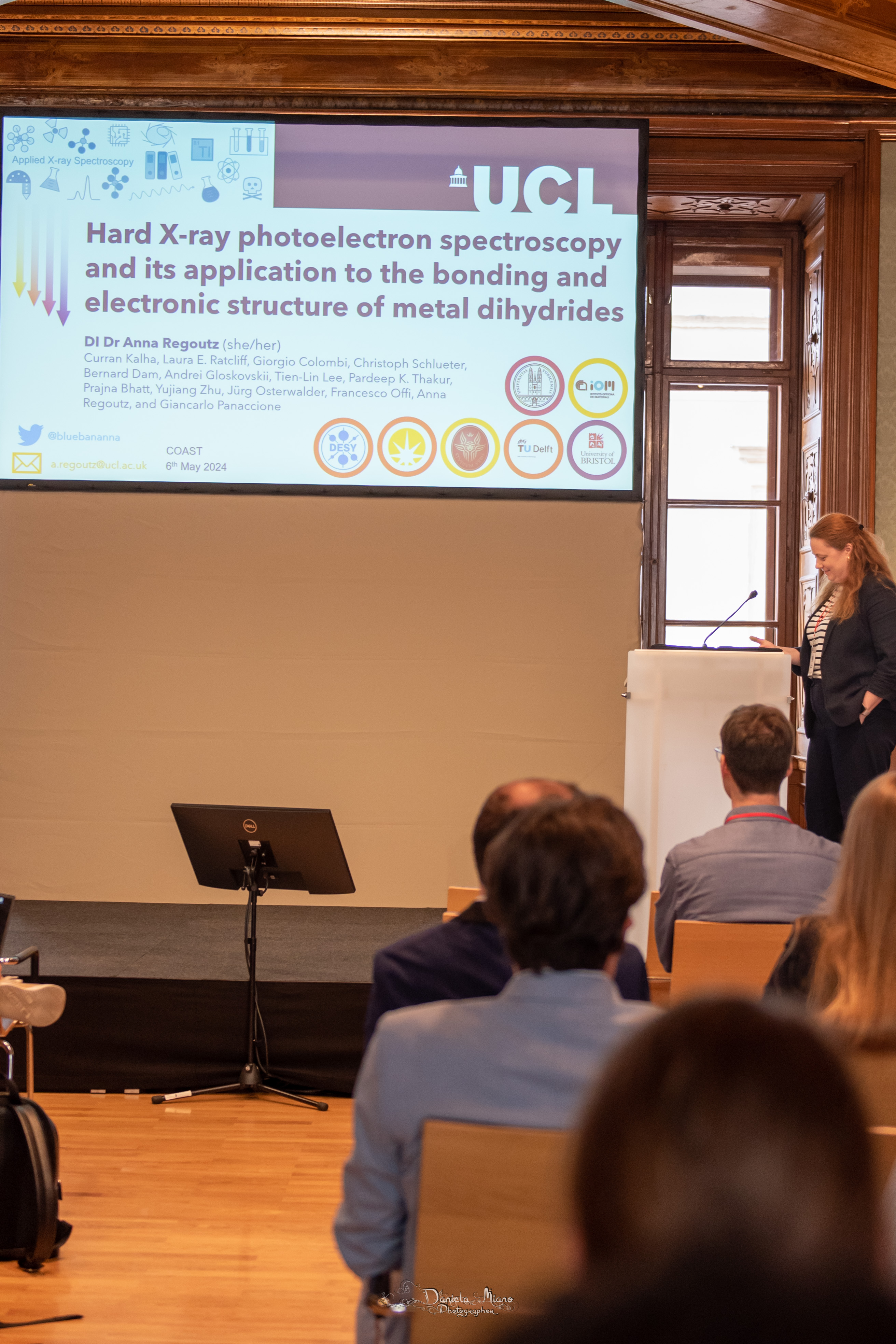
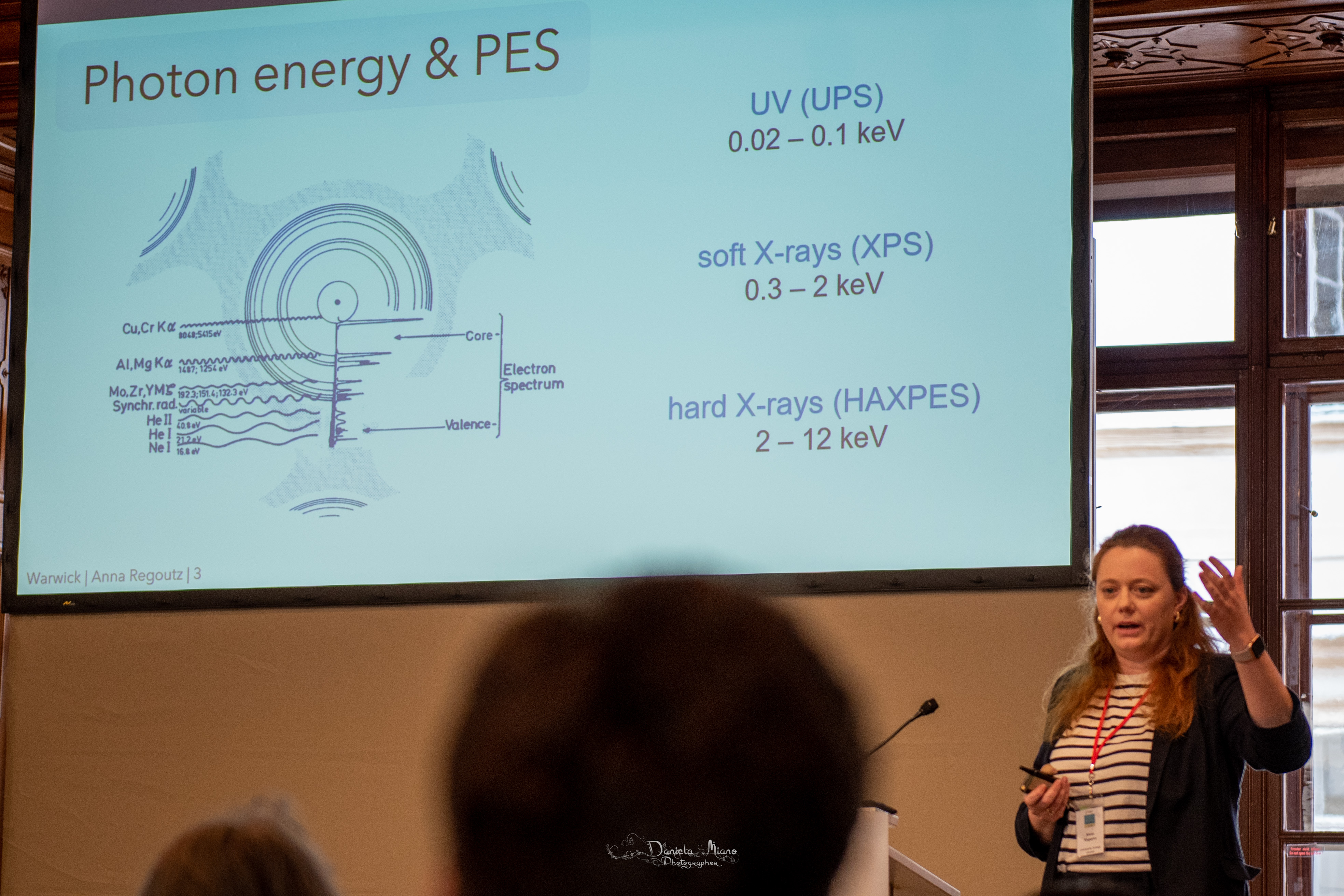
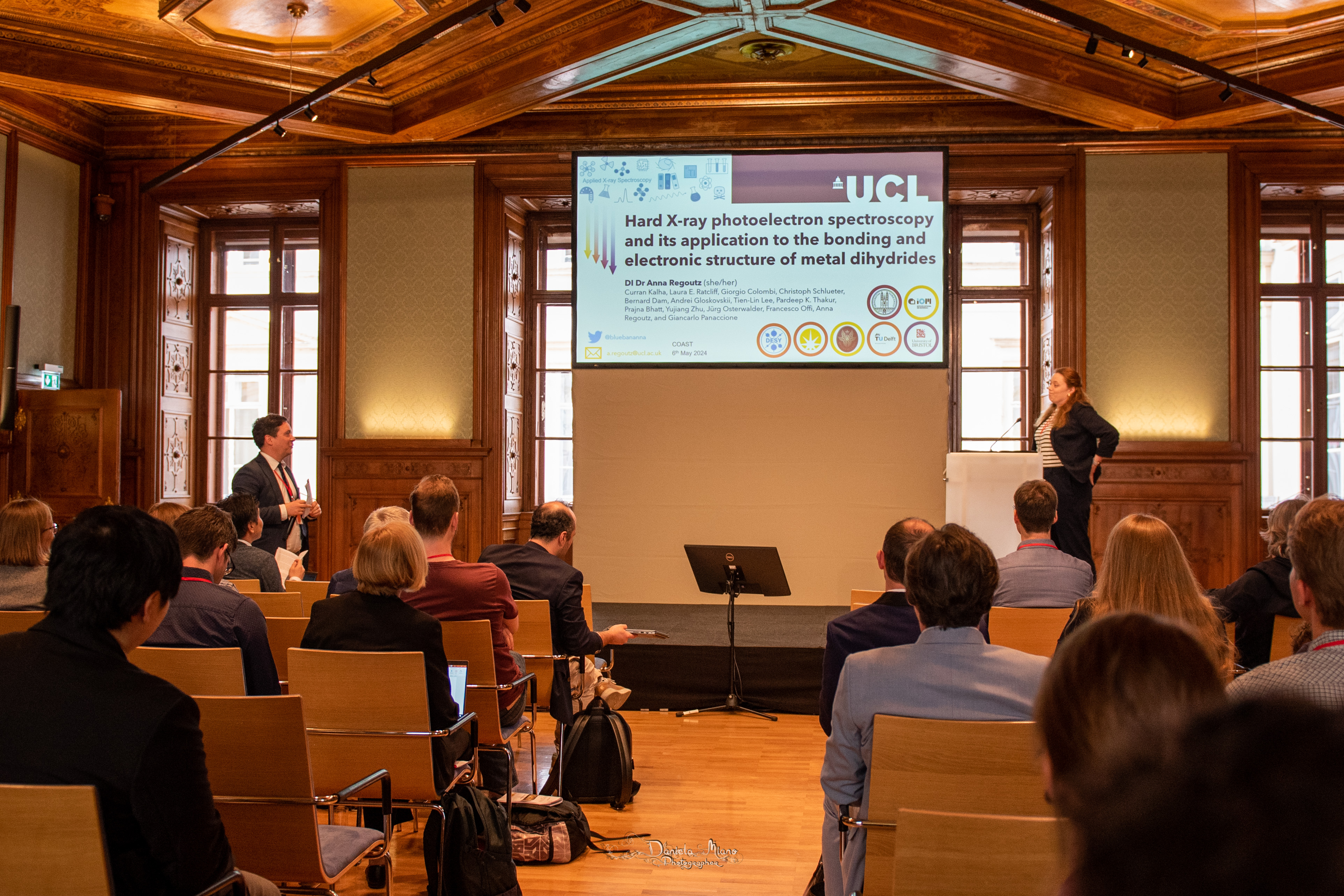
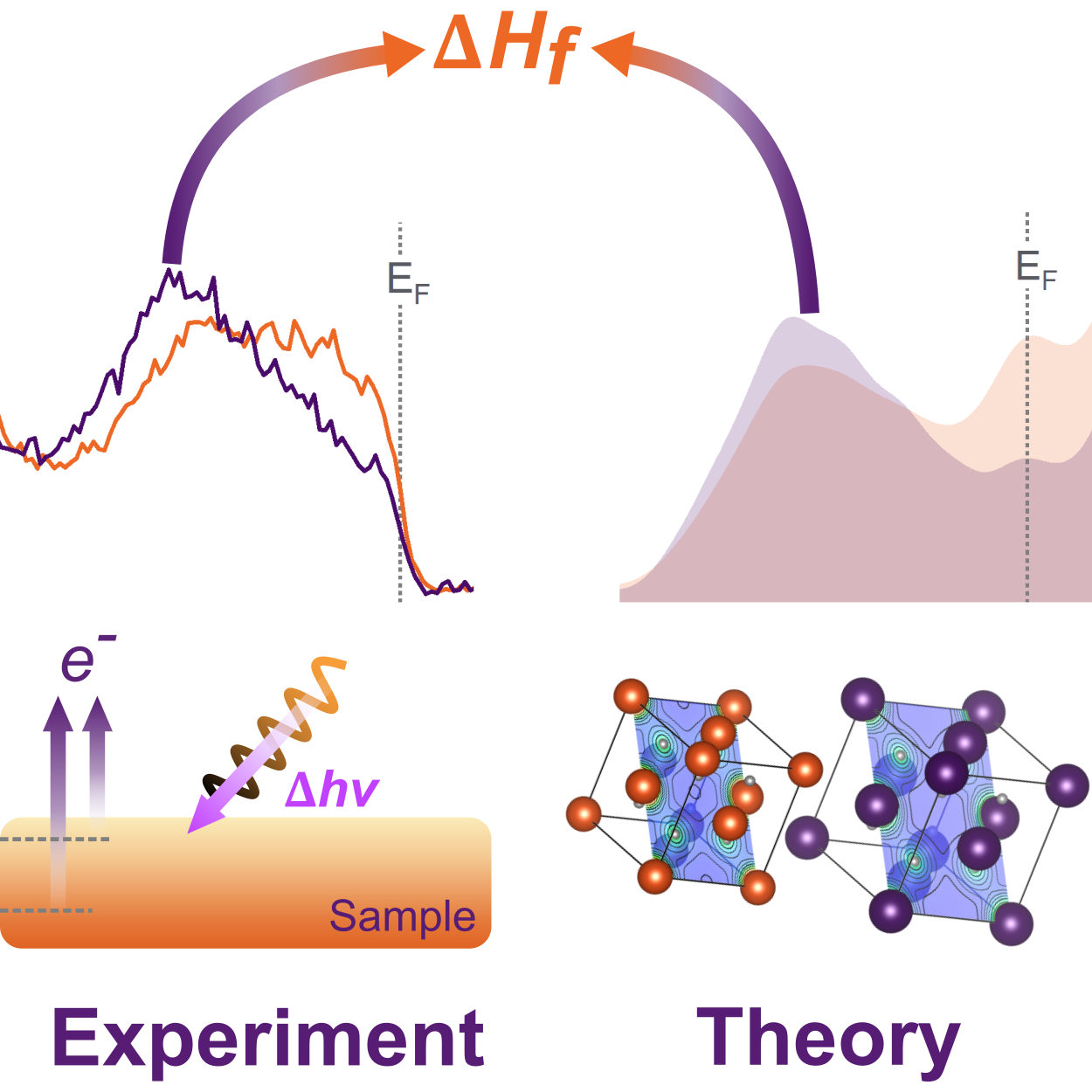
In early May, Anna attended the Conference on Applied Surface Technology (COAST) in the beautiful Palais Niederoesterreich in Vienna, Austria. She presented an invited talk on the group’s latest work on metal hydrides and the relationship between electronic structure and formation enthalpy. You can read more about it here and on arxiv.

Photo credit: Daniela Miano.


Connecting the dots in metal dihydrides

Over the past couple of years, we have worked hard on a (new to us) material family: transition metal dihydrides. These material are crucial for applications in hydrogen-related technologies, such as energy storage, hydrogen compression, and hydrogen sensing.

In a recently published work led by Curran, we developed a new analytical pathway to explore the relationship between chemical bonding, electronic structure and formation enthalpy of two prototypical metal dihydrides (yttrium and titanium dihydride).
Using hard X-ray photoelectron spectroscopy (HAXPES) at beamline P22 at PETRA III/DESY and by taking advantage of the tunability of synchrotron radiation, we created a non-destructive depth profile of the chemical states. We could provide a description of the bonding nature and the role of d versus sp contributions to states near the Fermi through combination of experimental valence-band spectra and insights from density functional theory (DFT) calculations, the latter was led by Dr Laura Ratcliff from the University of Bristol. Excitingly, we could determine the enthalpy of formation from both theoretical and experimental values of the energy position of metal s-band features close to the Fermi energy.

We were extra excited to see our work being highlighted by the National Research Council of Italy in a recent press release.


PhD project available

We have a PhD project available through the open DTP studentships on gallium oxide thin films for electronic devices. You can find the project description here (the project ID is 2228cd1383). The project will involve the development of a solution-based, energy-efficient manufacturing process for Ga2O3-based materials, the interfacing of Ga2O3 with varying metallisation schemes to create device-relevant heterostructures, and the use of advanced X-ray spectroscopy techniques to explore the formed interfaces.

This project is part of the competitive DTP studentship call at UCL. Depending on the qualifications of the applicants, this project may not necessarily lead to a studentship. You can find all the information about the application process here.

Get in touch with Anna, if you are interested and/or have any questions.