Regoutz Group


How to mitigate radiation damage? Exploring the dark side

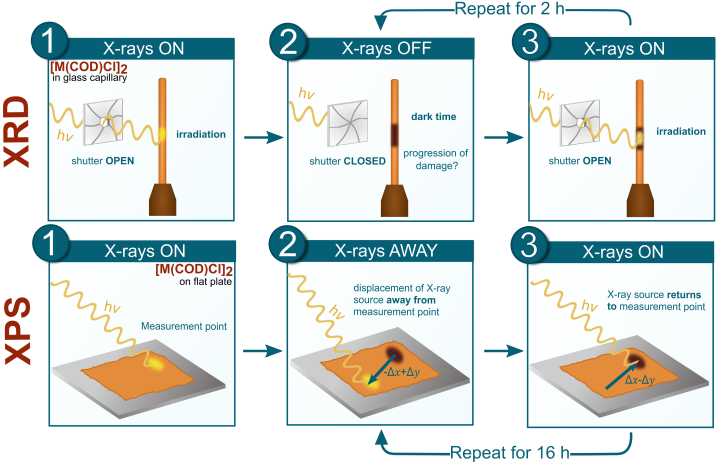
Investigating discontinuous X-ray irradiation as a damage mitigation strategy for [M(COD)Cl]2 catalysts
N. K. Fernando, C. A. Murray, A. L. Thompson, K. Milton, A. B. Cairns, and A. Regoutz, Physical Chemistry Chemical Physics, 27, 9417, 2025.

Radiation-induced changes have become an aspect of everyday life for many of us who use X-ray based techniques. With the ever increasing photon flux and ever decreasing beam footprints of laboratory and synchrotron systems radiation damage is becoming an increasing challenge for material characterisation using techniques such as X-ray spectroscopy and diffraction.

In our most recent exploration into this topic, led by Dr Nathalie Fernando, we explored a possible mitigation strategy, where short, X-ray-free “dark” periods are introduced in-between measurement windows. However, it is unclear whether this strategy helps to minimises radiation-induced damage or, in actuality, promotes it through a phenomenon called “dark progression”, i.e. the increase or progression of radiation damage that occurs after the X-ray beam is turned off. This work is now published in the RSC journal Physical Chemistry Chemical Physics.


Laying the groundwork for optoelectronic devices – the influence of stabiliser concentration on the formation of In2O3 thin films

The influence of stabiliser concentration on the formation of In2O3 thin films
A. A. Riaz, C. Kalha, M. Basso, M. Furedi, and A. Regoutz, Journal of Materials Chemistry C, 13, 177, 2025.

In2O3 is the parent oxide semiconductor for many transparent conducting oxides owing to its comparatively wide band gap and reasonable conductivity. The ability to fabricate thin films of In2O3 utilising simple and cheap solution-processed methods such a sol-gel has made it appealing for applications in displays and solar cells. The use of stabilisers in sol-gel synthesis is prevalent in current research to maintain the solution stability over time and facilitate the formation of strong M–O–M bonds. However, understanding the fundamentals behind the chemistry, especially the effect of varying the stabiliser concentration, is essential and often overlooked.

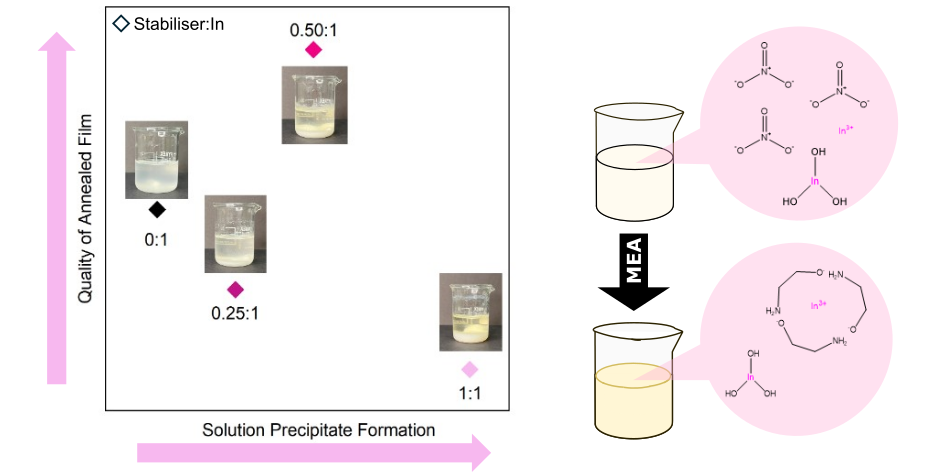
In our paper published in RSC Journal of Materials Chemistry C and led by Aysha Riaz, we show the impact on the quality of In2O3 thin films when altering the concentration of monoethanolamine used as a stabiliser. Utilising a combination of characterisation techniques such as X-ray photoelectron spectroscopy, atomic force microscopy, and ellipsometry to probe the chemistry of the thin films and UV-visible and infrared spectroscopy to follow the solution chemistry, the optimum stabiliser ratio concentration was determined.

This is the first first author research paper of Aysha’s PhD, with hopefully more to follow! Curran Kalha and Maria Basso provided support and training and the ellipsometry data were collected with the help of Máté Füredi.


Connecting the dots in metal dihydrides

Over the past couple of years, we have worked hard on a (new to us) material family: transition metal dihydrides. These material are crucial for applications in hydrogen-related technologies, such as energy storage, hydrogen compression, and hydrogen sensing.

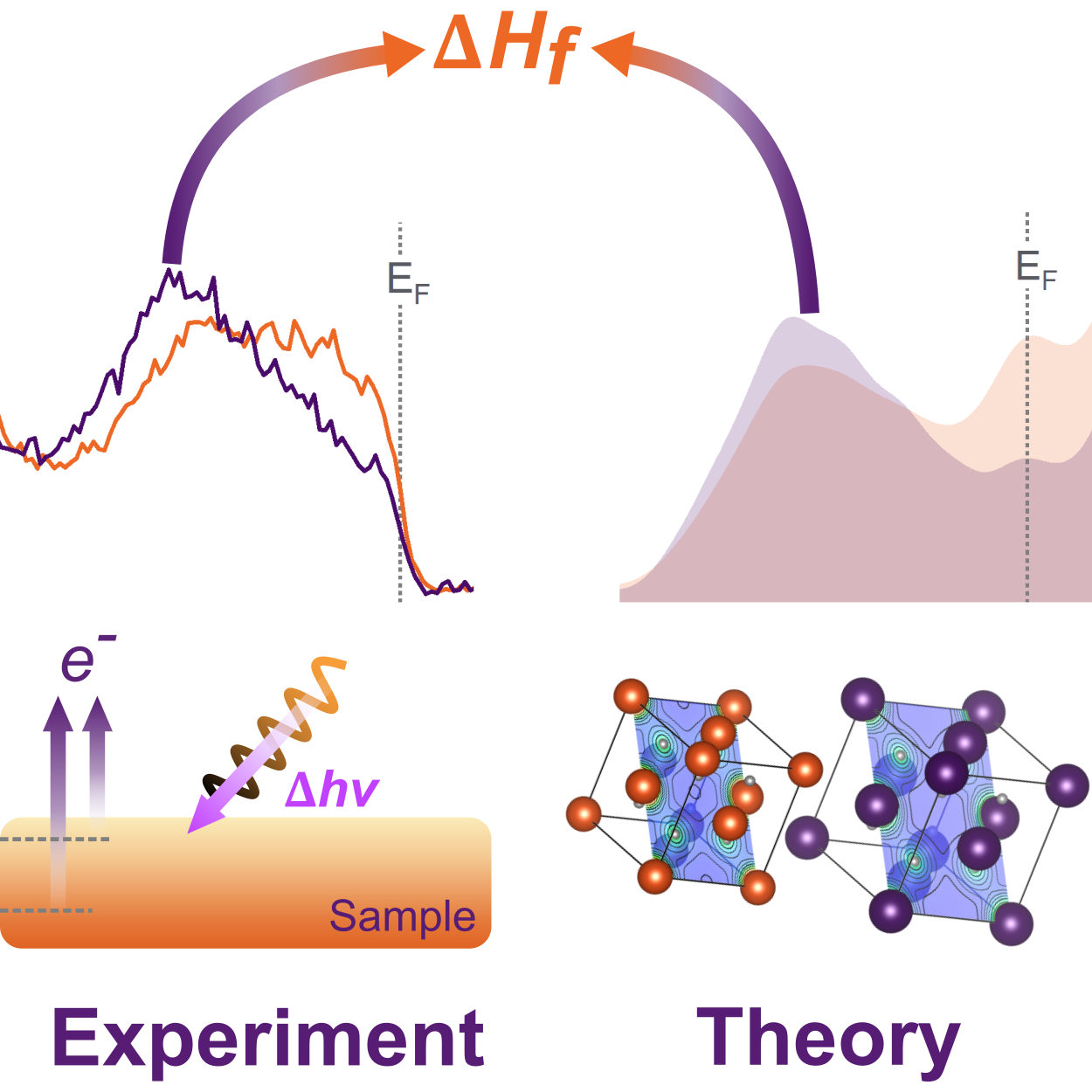
In a recently published work led by Curran, we developed a new analytical pathway to explore the relationship between chemical bonding, electronic structure and formation enthalpy of two prototypical metal dihydrides (yttrium and titanium dihydride).
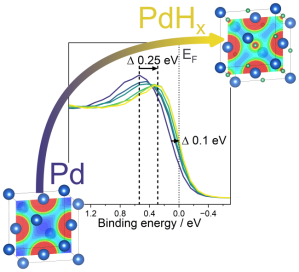
Using hard X-ray photoelectron spectroscopy (HAXPES) at beamline P22 at PETRA III/DESY and by taking advantage of the tunability of synchrotron radiation, we created a non-destructive depth profile of the chemical states. We could provide a description of the bonding nature and the role of d versus sp contributions to states near the Fermi through combination of experimental valence-band spectra and insights from density functional theory (DFT) calculations, the latter was led by Dr Laura Ratcliff from the University of Bristol. Excitingly, we could determine the enthalpy of formation from both theoretical and experimental values of the energy position of metal s-band features close to the Fermi energy.

We were extra excited to see our work being highlighted by the National Research Council of Italy in a recent press release.


Precision-guided! Tuning CuO nanostructure morphology by controlling synthesis temperature

CuO is a promising material in non-enzymatic glucose detection with advantages like high electrochemical activity, relatively low cost, and non-toxicity. When the material is nano-sized, its high surface area to volume ratio results in a greater number of active sites for the electron transfer process across the electrode, leading to a higher turnover reaction. A major challenge in the field is that various factors in the synthesis process impact the final product, thereby, leading to a different performance in glucose sensing.

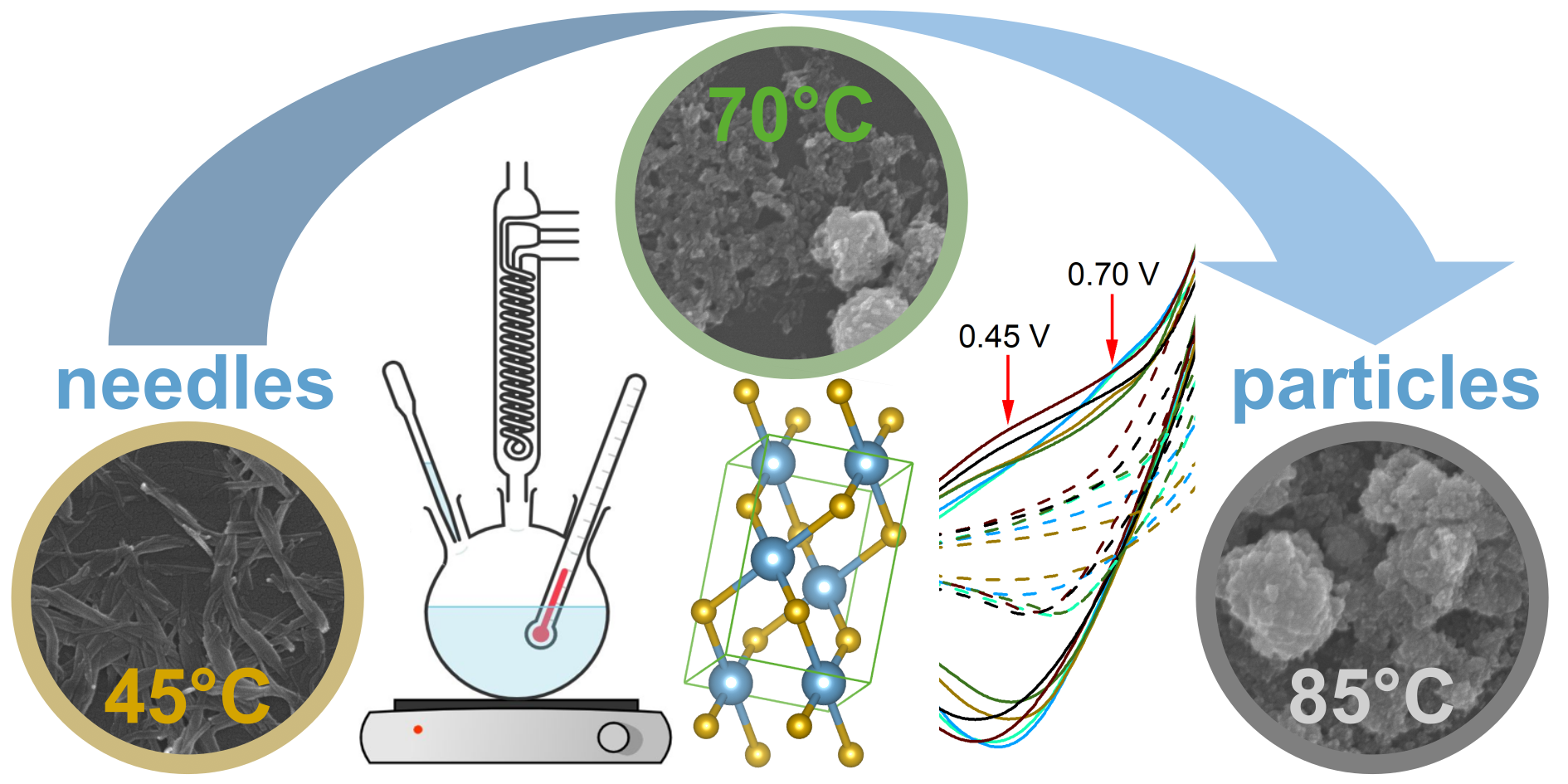
In our recent paper led by Yujiang Zhu and published in Materials Advances, we report that CuO nanostructures synthesised via a facile wet chemical precipitation method can be controlled by synthesis temperature to form specific morphologies. No matter what the synthesis temperature, all formed nanostructures are predominantly CuO with varying contributions from other surface species, and have the ability and selectivity to sense glucose. However, distinct differences are found in the morphology of the nanostructures found changing from nanoneedles to nanospheres with an increase in temperature. This goes hand in hand with a change in electrochemical behaviour. In the critical transition region, even changes of a few degrees completely change the morphology and electrochemical performance. This work helps to understand the critical relationship between synthesis temperature and final nanostructure and can explain the seemingly random nanostructures and sensing behaviour observed in the literature.

The paper also includes contributions from the MSci final year project of Carolina Vigil-Hernandez, who is currently pursuing a PhD with Simon Humphrey at the University of Texas at Austin. This work is the result of a long-standing collaboration with Dr Despina Moschou and her group from the Department of Electronic & Electrical Engineering at the University of Bath. In addition, we had great local support from Dr Gemma-Louise Davies and Steven Firth.

Do you want to know more about how different synthesis factors impact the formation and sensing behaviour of CuO nanostructures? Stay tuned for more papers by Yujiang coming soon!


Where is my titanium going? Testing the stability of TiW barriers

Hot off the press! Check out our latest collaboration with colleagues from Infineon Technologies Austria, KAI and HarwellXPS, exploring the interface stability of TiW/Cu heterojunctions using SXPS and HAXPES. This work marks the second publication in a series by Curran Kalha on TiW diffusion barriers and continues a long and fruitful collaboration with beamline I09 at the Diamond Light Source.

Diffusion barriers are essential components in power semiconductor devices and are designed to isolate metallisation schemes from the semiconductor devices. The binary alloy of titanium-tungsten (TiW) is an established diffusion barrier for copper metallisation schemes. However, little has been established regarding the chemical state of the TiW/Cu interface or the possible degradation mechanisms of the barrier during annealing.

In our recent paper in Journal of Applied Physics (the preprint is also on arxiv), we show that the TiW alloy is an excellent barrier for copper metallisation schemes, successfully isolating the copper after annealing for as long as 5 h at 400°C using both synchrotron-based SXPS and HAXPES. Under thermal stress the barrier starts to degrade via the out-diffusion of Ti, but using laboratory-based SXPS at HarwellXPS it is clear that the Ti quantity lost in the diffusion barrier does not significantly impact the performance of the barrier.

Stay tuned for more TiW research and the completion of Curran’s TiW trilogy (and maybe a prequel or origin story too).


Implementing inorganic materials in affordable, flexible biosensor platforms

Integrating inorganic materials, that show great potential for sensing application, into platforms that are suitable for the industrial production of cheap, non-invasive sensors is of great importance for their broad implementation. In our recent open access paper in Materials Research Express, we show the successful integration of copper oxide based electrodes for glucose sensing on printed circuit board (PCB) technology. Together with collaborators at the University of Bath led by Dr Despina Moschou we could show that direct oxidation on PCB compatible substrates is possible and how production parameters including annealing duration and temperature influence the surface morphology and chemistry as well as influencing the resulting electrochemical sensing properties.

The work in the paper is based predominantly on the Masters research of Shijia Liu and Ayse Ay, who did their Masters projects as part of their MSc in Advanced Materials Science and Engineering degrees in the group in the academic year 2017/18. The research also included the involvement of two UROP (Undergraduate Research Opportunities Programme) students, Qiaochu Luo and Xiangqi Hu.


Polarisation dependent HAXPES – New paper out

A little while ago now Chemical Physics Letters published our paper on polarisation dependent hard X-ray photoelectron spectroscopy (HAXPES). This technique is still relatively new and not many publications are available. It shows particular potential for the identification of s states in valence band. The experiments were undertaken at the Taiwanese beamline BL12XU at SPring-8.

You can find the full article on the Chem. Phys. Lett. website

chemphyslett


New paper in press – Ga:In2O3

Finally, this beast of a paper has been accepted and is currently in press. You can already find the accepted manuscript on the Elsevier website. After a long review process I am very relieved that this is finally done. Now waiting for the proof and then the final version will hopefully be available soon. But with 19 figures and the current manuscript having a whopping 51 pages this might take a moment or two.

paper