
A. A. Riaz, C. Kalha, M. Basso, M. Furedi, and A. Regoutz, Journal of Materials Chemistry C, 13, 177, 2025.
In2O3 is the parent oxide semiconductor for many transparent conducting oxides owing to its comparatively wide band gap and reasonable conductivity. The ability to fabricate thin films of In2O3 utilising simple and cheap solution-processed methods such a sol-gel has made it appealing for applications in displays and solar cells. The use of stabilisers in sol-gel synthesis is prevalent in current research to maintain the solution stability over time and facilitate the formation of strong M–O–M bonds. However, understanding the fundamentals behind the chemistry, especially the effect of varying the stabiliser concentration, is essential and often overlooked.
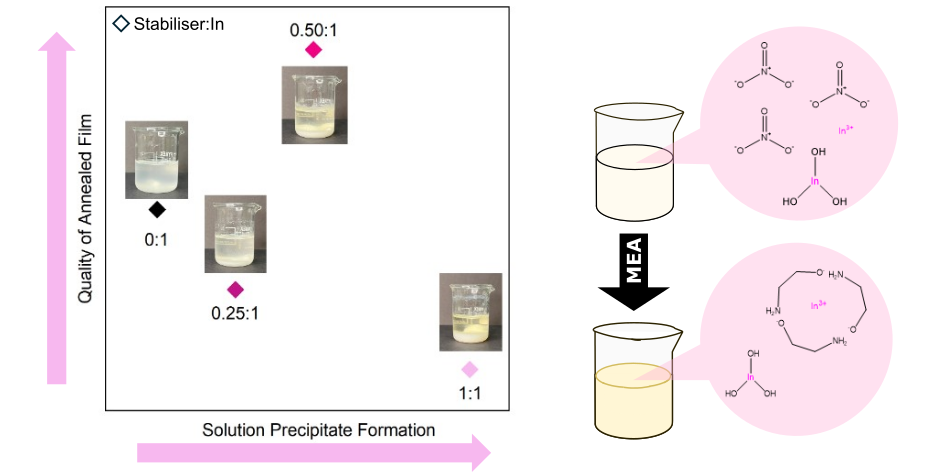
In our paper published in RSC Journal of Materials Chemistry C and led by Aysha Riaz, we show the impact on the quality of In2O3 thin films when altering the concentration of monoethanolamine used as a stabiliser. Utilising a combination of characterisation techniques such as X-ray photoelectron spectroscopy, atomic force microscopy, and ellipsometry to probe the chemistry of the thin films and UV-visible and infrared spectroscopy to follow the solution chemistry, the optimum stabiliser ratio concentration was determined.
This is the first first author research paper of Aysha’s PhD, with hopefully more to follow! Curran Kalha and Maria Basso provided support and training and the ellipsometry data were collected with the help of Máté Füredi.
 Regoutz Group